


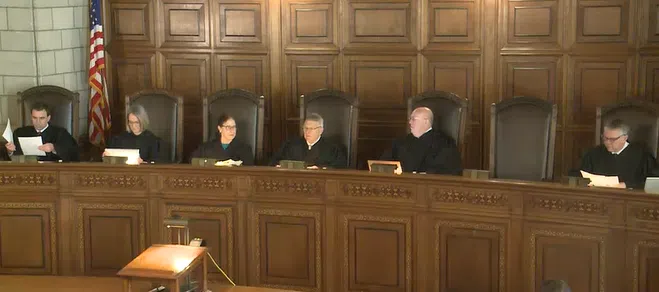
Lincoln voters will decide at least three proposed changes to the City Charter this November after the Nebraska Supreme Court rejected the city’s position that the measures should wait until its May 2027 municipal election.
In a 5-2 decision Wednesday, the state’s highest court granted Attorney General Mike Hilgers’ request for a writ of mandamus, ordering Lincoln officials to submit all three citizen-initiated amendments from Good Government Lincoln to voters at the November 3 general election.
The ruling resolves a dispute over how the Nebraska Constitution applies to citizen-initiated amendments to a home-rule city charter.
The Lancaster County Election Commissioner had already certified that each of the three petitions contained enough valid signatures to qualify. The central dispute before the Supreme Court was not whether the measures qualified, but when Lincoln was legally required to submit them to voters, according to the Nebraska Examiner.
Court says November is the required election.
The Nebraska Constitution provides that qualifying charter amendment petitions are to be submitted to voters at the next general or special election not held within 30 days after the petitions are filed.
Good Government Lincoln submitted its latest petitions August 19 — 76 days before the November 3 election, according to the Nebraska Attorney General’s Office.
The city determined the amendments should go before voters at Lincoln’s May 2027 municipal election. Hilgers challenged that decision, arguing the Nebraska Constitution required the proposals to be submitted at this November’s statewide general election.
City officials maintained that Lincoln’s established charter-amendment process — including legal review, consideration of possible alternative amendments, Charter Revision Commission review, public notice, City Council meetings and an opportunity for public comment — could not be completed before the September 1 ballot-certification deadline.
The Nebraska Supreme Court sided with Hilgers on the central legal question.
The majority cited prior Nebraska court decisions to conclude that the terms “general” and “regular” election have been used interchangeably. The court determined that the November statewide general election satisfies the constitutional requirement.
In its per curiam, or unsigned, majority opinion, the court also concluded that Hilgers had established the requirements for mandamus: a clear right to the requested relief, a corresponding duty on city officials to act, and no other adequate remedy.
The result is that all three proposed amendments must be submitted to Lincoln voters November 3.
Three proposed changes to city government
The three Good Government Lincoln proposals would make separate changes to Lincoln city government and elections.
One would limit members of the Lincoln City Council to two consecutive four-year terms.
Another would move Lincoln’s city elections from odd-numbered years to even-numbered years, aligning municipal elections with statewide general elections.
The third would allow certain eligible residents living within Lincoln’s roughly three-mile extraterritorial jurisdiction (ETJ) to vote in municipal elections. Bond elections would be excluded. (Nebraska Examiner)
Voters could see alternative proposals.
The three citizen-initiated amendments may not be the only charter proposals Lincoln voters see in November.
Although the Supreme Court divided 5-2 over whether the Good Government Lincoln measures must appear on the November ballot, the court unanimously preserved the City Council’s constitutional authority to submit alternative charter language to voters.
The court said nothing in its opinion should be interpreted as impairing the constitutional right to submit an alternative article or section. (Nebraska Examiner)
That could become the next significant development in the charter dispute.
City Council Chair Brodey Weber told the Supreme Court in an August 31 affidavit that he and other council members had expressed interest in considering or offering alternatives to the Good Government Lincoln proposals.
Weber said city officials needed adequate time to engage in that legislative process, which was one reason cited for putting the amendments on the May 2027 ballot instead.
Following the Supreme Court ruling, City Attorney Yohance Christie indicated alternatives remain under consideration.
Christie said the city will comply with the ruling and move forward with placing the charter amendments and any alternatives on the November ballot. (Nebraska Examiner)
Hilgers praises ruling
Hilgers called the decision significant both for Lincoln voters and for the application of the Nebraska Constitution.
“The Court’s decision today is important not only for the citizens of Lincoln, but for the rule of law in Nebraska,” Hilgers said.
The Attorney General sharply criticized the city’s handling of the petitions, accusing Lincoln elected officials of playing “political games” rather than obeying the Constitution. He said the Supreme Court had protected Lincoln voters’ right to participate in their government at the ballot box. (Nebraska Attorney General)
Those comments reflect Hilgers’ characterization of the dispute. City officials maintained that their position was based on their interpretation of Lincoln’s home-rule charter, state election deadlines, and the procedures required to consider charter amendments.
The city had planned to put the proposals before voters in May 2027, while Hilgers argued the Nebraska Constitution gave city officials no discretion to delay submission until then.
Hilgers also has a personal connection to one of the issues involved. The Nebraska Examiner reports that Hilgers lives outside Lincoln within the city’s three-mile extraterritorial zoning jurisdiction and has acknowledged supporting Good Government Lincoln’s efforts. One of the proposed amendments would extend voting rights in certain Lincoln municipal elections to eligible ETJ residents. (Nebraska Examiner)
The Supreme Court ruling did not address Hilgers’ support for the proposals as a legal issue in deciding whether the amendments must appear on the November ballot.
City will comply but raises concerns.
Christie said Lincoln will comply with the Supreme Court’s order but expressed disappointment with the decision.
The city maintains the accelerated timetable reduces the time normally available for reviewing proposed charter amendments and educating voters about their potential effects.
Christie said the city shares concerns expressed by Justice Stephanie Stacy in her dissent that requiring the City Council to submit the local measures during the November statewide election creates conflicts with provisions of Lincoln’s home-rule charter and established Election Act timelines.
Christie also expressed concern that eliminating steps in the normal public process could undermine public understanding and confidence in the ballot process.
Dissent warns of possible confusion.
Justice Stephanie Stacy dissented from the majority ruling. She was joined by Nebraska Court of Appeals Judge Michael Pirtle, who participated in the case because Chief Justice Jeffrey Funke did not take part.
Stacy argued that the majority’s interpretation of the Nebraska Constitution was unsupported by the constitutional text and conflicted with Lincoln’s home-rule charter.
She said requiring the City Council to submit what she characterized as a strictly local matter during the statewide November election would force city officials to disregard portions of Lincoln’s charter and established timelines under the Nebraska Election Act.
Stacy also questioned the need for the court to expedite the measures.
According to the Nebraska Examiner, Stacy said she saw nothing in the record demonstrating specific harm that would result from waiting until Lincoln’s May 2027 election. She warned that granting the writ instead could create “disorder and confusion” for election officials and voters. (Nebraska Examiner)
Second petition drive followed alleged signature fraud
The legal battle followed an unusual path to getting the amendments qualified.
Good Government Lincoln initially submitted petitions in July, but all three measures failed to qualify after large numbers of signatures were rejected amid allegations of petition fraud.
Plains Sentinel reported that more than 65 percent of the signatures from the initial submission were determined to be fraudulent. Good Government Lincoln then launched another petition effort and submitted more than 9,000 signatures for each amendment in August. (The Plains Sentinel)
The alleged fraud led to a broader law enforcement investigation into petition-gathering activity.
The Lincoln Journal Star reported that six people had subsequently been arrested outside Nebraska in connection with alleged fraud involving the earlier Good Government Lincoln petition effort.
Good Government Lincoln has portrayed itself as a victim of the alleged fraud. Former state Senator Tony Fulton, a sponsor of the effort, thanked Lancaster County officials and law enforcement for investigating what he described as an attempt by individuals to defraud the petition system. (The Plains Sentinel)
Fulton says voters will have final say
Fulton praised the Supreme Court ruling.
He said the decision means Lincoln voters will have the final say on City Council term limits, increased participation in city elections and whether eligible residents living outside the city but subject to Lincoln government should be allowed to vote for city officials.
The three proposals will now appear before Lincoln voters during the November 3 general election.
The remaining question is whether the City Council will exercise its constitutional authority to develop alternative amendments before the ballot is finalized.
Beyond the immediate Lincoln dispute, the Supreme Court ruling also establishes an interpretation of Nebraska’s constitutional process for citizen-initiated amendments to home-rule city charters.
The majority concluded that the constitutional requirement to submit qualifying petitions at the “next general or special election” required Lincoln to use the November statewide general election rather than wait until the city’s next regularly scheduled municipal general election in May.
That interpretation — and whatever alternative proposals the City Council may now develop — will shape the next stage of Lincoln’s charter debate.
Sources: Nebraska Supreme Court proceedings and ruling; Nebraska Attorney General’s Office; Nebraska Examiner; Plains Sentinel.
Nebraska Examiner — Supreme Court ruling coverage
Nebraska Attorney General — Hilgers statement
Plains Sentinel — petition background