



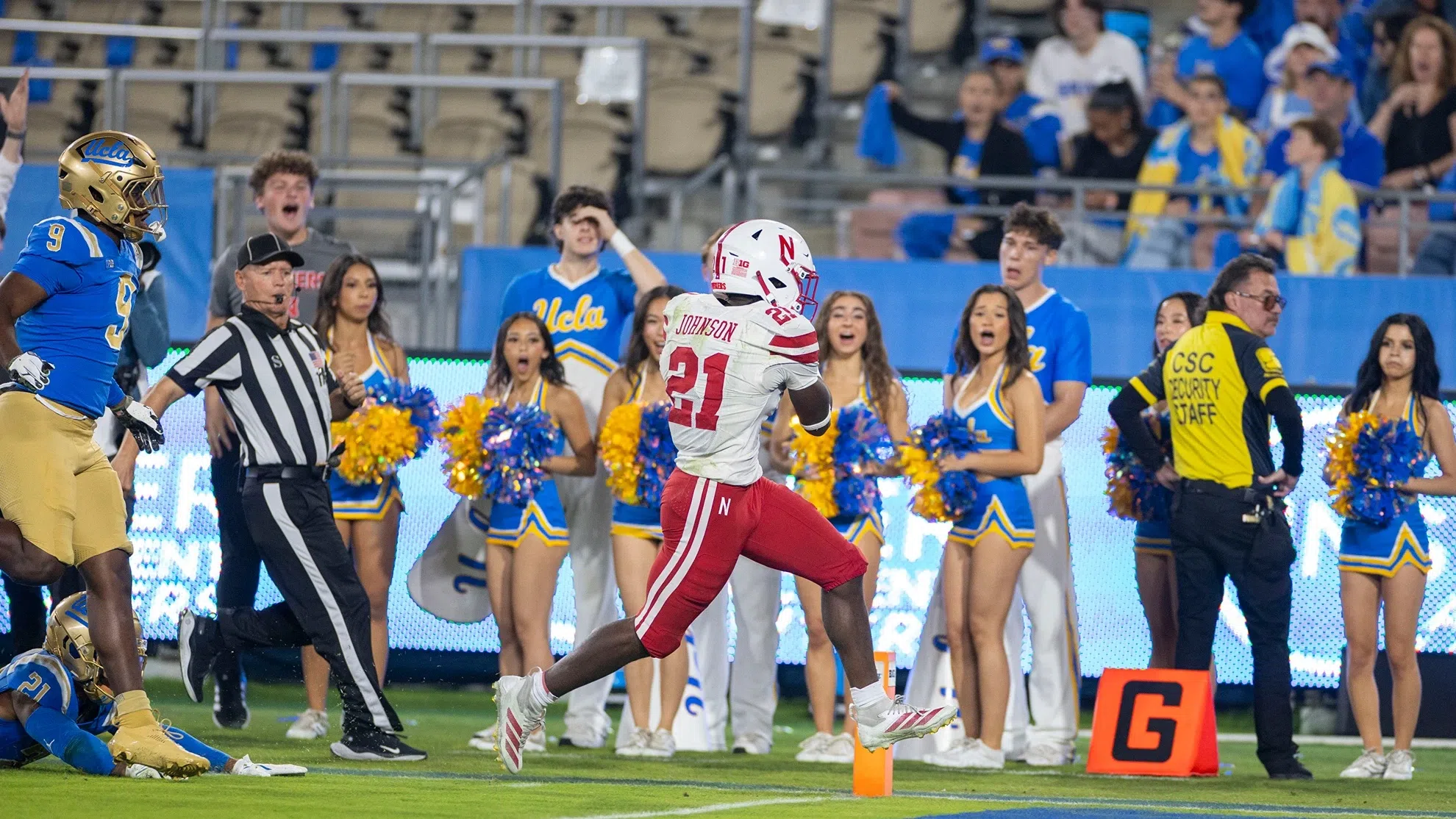
Rohr’s Four: Four reactions, impressions, reflections, concerns and questions after Nebraska’s 28-21 win at UCLA.
1-Appreciate Johnson’s magic, before it disappears
When Dana Holgorsen was hired as Nebraska’s offensive coordinator with three games to go last year, one of his first acts was to bring clarity to the Huskers’ running back room. No more four Ors-men. No more splitting carries. Emmett Johnson is the guy, and the plays will be called as such.
The results are indisputable. Johnson has grown from a promising and decent, but not gamebreaking, option in the backfield to the best running back in the Big Ten. In turn, Johnson has gotten into a rhythm, developed his vision, gotten stronger and quicker, and gained confidence with each carry and catch.
Saturday night at the Rose Bowl was Emmett Johnson’s masterpiece. Everyone in the building (even the few not clad in red) knew Emmett Johnson was likely to get the ball every play he was on the field, and their prophecies were often correct. Taking out Nebraska’s four kneeldowns to burn off halves, and the Cornhuskers had precisely 50 offensive snaps. Johnson had 31 touches. So Johnson basically got the ball (either on a run play or pass play) two out of every three plays. The numbers skew even more heavily when you take out the handful of plays Johnson took off.
And yet, every time he touched the ball, electricity ran through the air. How about the 56-yard screen pass he took to the house? He disappeared from the grasp of the Bruins defenders and darted down the right sideline. And he lost yardage on only one run for the game. Every time he was handed the ball, he squirmed, shrunk, slipped, spun, and found daylight where few others could.
No wonder that the language used to describe him has shifted. In the Nebraska athletic department’s media notes after the game, Johnson had a new prefix added to his name: All-America candidate running back. And deservedly so. With three weeks to go in college football’s regular season, Johnson ranks first in the Big Ten and second nationally in rushing yards. Second in the Big Ten and fifth nationally in rushing yards per game. Second in the Big Ten and fourth nationally in total touchdowns. This is a historic year, deserving of a place at least next to Ameer Abdullah and Roy Helu and Rex Burkhead as the best by a running back in the 21st century of Husker Football.
This is where I turn into wet blanket: Enjoy what we’re seeing from Emmett Johnson. Because it might only be there for two more games in Husker red.
Our conversations during the Friday Husker Tailgate created this view, and I think Jack Mitchell was the first to plant the possibility in my head, as we first wrestled with the possible NIL tab to keep Johnson at NU, then considered other options.
Johnson flirted with the transfer portal briefly after last season, only to be convinced to come back. Certainly, another school may be watching Johnson’s production, thinking it is merely a running back away from the national championship, and pulling together an NIL offer that the Johnson family may not be able to refuse. Certainly, the Nebraska boosters will pull together a competitive financial package, but Matt Rhule’s appeals to the Husker fan base would suggest money is at least a minor concern as Nebraska swings bigger in both the recruiting and retention aspects of roster building.
But it’s the second, more conventional exit ramp that may end Johnson’s time at Nebraska. A quick check on ESPN NFL Draft expert Mel Kiper’s most recent prospect rankings placed Johnson as the eighth-best draft eligible running back in the Class of 2026. Care to guess who was the eighth running back selected in last year’s NFL Draft? Cam Skattebo. Before his gruesome ankle injury a couple weeks ago, Skattebo was producing at a high level for the New York Giants. He was drafted in the fourth round and received a signing bonus of roughly $1.1 million, on top of a base salary of around $650,000 per season.
Those financial parameters aren’t iron-clad, but do give you a ballpark of what Johnson will be looking at in the offseason. The shelf life of running backs in the NFL is as short as that of the latest TikTok trend (though, as the dad of an elementary school kid, the whole 6-7 thing can go away any time now). Johnson will have 16 games of great tape, a smaller workload of only one season as Nebraska’s true bellcow running back, and the most positive buzz behind him he may ever have, especially in an era when 2,000 rushing yard seasons are totally out of reach.
The fact of the matter is that the getting might be too good for Johnson to pass up leaving early for the NFL. This is a good problem to have. Even in the vaunted glory days of the Nebraska football program, running backs left early for the NFL. In fact, three in a row, Calvin Jones, Lawrence Phillips and Ahman Green, left after their junior seasons to try their luck in the League.
But it’s not a problem the Huskers have had to deal with lately (though Thomas Fidone did technically leave early for the NFL after last season, but his career was unconventional with medical redshirts and COVID years). This is a first-world problem of having good players, and certainly beats the alternative of not having NFL-caliber players.
Maybe Johnson stays. Boy I hope he does. And I’m sure the well-heeled Husker fans are being compelled to pool their money in a way that would make one more year in Lincoln worth his while. All I’m saying is that Emmett will have a tough decision on his hands 15 minutes after the Iowa game, and if he were to decide to head to the NFL, I’ll tip my red cap to him and wish him well. He’s certainly shown that he’s ready to make that next step.
2-The quarterback question
If you would’ve told me in August’s swelter that, the morning I saw the first flurries of November, I’d be wondering about Nebraska’s quarterback situation, I’d be worried that the heat stroke was getting to you.
In this space, I’ve been dismissive of the view that TJ Lateef is a better quarterback than Dylan Raiola, at least right now. I didn’t believe that the Huskers would be better served sitting their highly talented quarterback, brought up in a football household to read defenses and deliver the ball downfield, in favor of a true freshman runner. Nevermind the talent attracted by a returning, five-star quarterback. No way Nyziah Hunter and Dane Key come here for a true freshman quarterback, and Johnson is maybe more aggressive in looking for somewhere else to go.
I’m still not convinced I’m wrong. UCLA’s defense came in with putrid numbers: worst run defense in the Big Ten and 124th in the nation (there are only 136 Division I FBS teams), 78th in the nation in total defense, 113th in the country in scoring defense. And Dana Holgorsen did the wise thing, especially with a true freshman QB on the road: feed your All-America candidate running back, and when you drop back your quarterback, give him limited options to throw to, then let him run.
With that said, the Nebraska offense was at its sharpest and most fluid in weeks against the Bruins. The offensive line embraced its task of paving the way for Johnson’s wizardry, and Johnson was magic, a terrific eraser for any mistakes that the line made. The two throws Lateef was asked to make on that first drive were right on target, and thrown with strength and conviction. Lateef seemed to have a limited menu of reads, if not plays to work with, cycled through his options quickly, and if it wasn’t there, he ran. By the way, he utilized that running option less than some thought he would, in part because Johnson was getting and deserved the bulk of the carries and in part because Lateef was able to get the short, quick passes out of his hands long before the Bruins’ pass rush to get to him.
It’s tough, exactly, to quantify how the possibility of Lateef running the ball affected the Bruins defense. Did Lateef’s legs force UCLA to devote at least some resources to slow him down, to the profit of Johnson and even Nebraska’s receivers with fewer eyes on them? It’s at least a possibility.
But it is likewise a possibility that a struggling defense, operating without near as much information as they would’ve against Raiola, just didn’t know where to go against Lateef, and by the time they had that information, the clock was bleeding dry.
Lateef played well. Acknowledging that UCLA’s defense is one of the worst in the Big Ten takes nothing away from Lateef did, especially making his first collegiate start just 25 miles from where he grew up. But before the starting quarterback job is handed to Lateef moving forward, as some fans want to do, what does he do against Penn State (not the ’85 Bears, ranking 13th in the Big Ten in rush D, but 36th in the nation in total defense and 51st in the country in scoring defense) and Iowa (always nasty on defense, fourth in the Big Ten and 17th nationally in rush defense, fourth nationally in total defense and fourth nationally in scoring defense)? Then get back to me.
3-The quarterback question, continued
And yet, I wonder. Let’s assume Raiola comes back, at least as good as ever. The arm talent, the football IQ, the experience and the pedigree (along with precedent) all suggest he’s entered immediately back into the starting role as the page turns to 2026. Whether the next three games from Lateef are good or not, he’ll get strong overtures from schools around the nation, enamored with his mobility, quick-decision making and poise. Moreover, other schools are likely to have an open job at quarterback. Unless Raiola leaves, the best Lateef can hope for Nebraska is a chance to battle for it.
Philosophically, does Nebraska want the dropback quarterback or the dual-threat?
A five-star quarterback is a lottery ticket for any program, but especially one for a program that had missed bowl season for seven straight seasons. But even as the Huskers earned an unqualified good break, there have been issues. Was a dropback, pro-style quarterback the best fit for a program that is rebuilding? Would the line hold up well enough and long enough to allow Raiola to use his arm talent and football IQ? Sometimes, the answer has been yes. Sometimes, it’s been no.
A mobile quarterback is the ultimate mistake eraser. Whiff on a block up front? He can get away from a heat-seeking missile at defensive end. He can hold a linebacker in place with a run fake. The possibility of his running the football takes heat off a running back on all sorts of option plays. Pass-game reads can be simplified. Drop back, see what’s there, and if it isn’t, tuck and run.
In some ways, a five-star, pro-style quarterback in a rebuilding program is like dropping a souped-up engine into an old car. Yes the engine can go fast. Yes it can do a lot of good things. But for you to really go as fast and as nimbly as you can, you need better tires. You need stronger suspension. The body of the car has to be right to create the right aerodynamics. You can punch the gas straight to the floor, and the engine will rev as hard as ever and put out as much power as ever, but you’ll go all over the road because the rest of the car just isn’t ready for that set of abilities.
Maybe Lateef is happy to continue his apprenticeship on the sidelines, picking the brain of Raiola at every opportunity while filling in downfield passing ability around his already present athleticism, poise and decisiveness. Maybe Raiola sees what Lateef has done in reading more decisively and running more willingly and integrates that into his game. That would certainly be the dream scenario for Rhule and the Huskers.
But this isn’t 1995. The odds are very, very slim, in today’s conditions, that Brook Berringer would’ve sat behind Tommie Frazier. Eric Crouch needed to be convinced to return to the team after he left in disappointment when Bobby Newcombe was named the starter in 1999. Whichever quarterback is sitting second on the depth chart has considerable incentives of immediate playing time and money to leave. As the last couple games play out, especially if Lateef plays well against Penn State and Iowa, it may be worth at least examining the question, especially in an era where scarce resources (NIL and rev-share money) dictate that a decision be made that benefits one and hurts the other beyond playing time.
4-The Big Ten West goes west
That question is also framed by the conference in which Nebraska plays, and the football that it usually requires. It was striking to me that, watching games Saturday, three of the newest entrants to the Big Ten either executed or endured the gritty, trench warfare, three-yards-and-a-cloud-of-dust football that has been the order of Big Ten football since Fielding Yost was lugging brown jugs down the Michigan sidelines in the early 1900s. In case anyone thought that the consolidation of the Big Ten into one division would erase Big Ten West-style football–ground and pound, line of scrimmage sausage ball–and bring more of the Pac-12 to the Big Ten, Saturday’s games were testimony that the playbooks and game styles of Barry Alvarez, Bo Schembechler and Woody Hayes (to say nothing of modern-day practitioners Bret Bielema, PJ Fleck and Kirk Ferentz) still hold sway.
Watching the Oregon/Iowa game, played in rain/sleet conditions that made Kinnick Stadium even more miserable than usual, Oregon had to grit its teeth, benefitting from a rare Iowa special teams disaster (a high snap on a punt, resulting in a safety), and still needed to churn away and assemble a last-minute drive to set up a game-winning field goal to knock off the Hawkeyes and stave off another dose of Kinnick magic.
After that, Washington battled a sputtering, drain-circling Wisconsin. In front of a half-empty, two-thirds-disinterested Camp Randall Stadium in Madison marinating in a wintry mix, the Huskies knocked the Badgers’ starting quarterback out of the game, then saw as his backup did his best Harrison Beck impression (Carter Smith, three-for-12, eight yards). Wisconsin’s leading passer was the punter, for heavens’ sakes! Easy win for Washington, right? Wrong. Wisconsin 13-10.
Then, in the conference nightcap, UCLA took the field in usually pleasant conditions in the Rose Bowl. But even as the Bruins’ opponents, Nebraska, fed their running back 28 carries, UCLA kept the ball in the hands of its quarterback. Surely Nico Iamaleava would make Troy Aikman and Cade McCown proud and sling it around the lot? Nope. On a 17-play, 75-yard, 9-minute, 46-second slog through the pristine turf in the shadow of the San Gabriels, Iamaleava ran it five times for 33 yards, picking up two third downs and a fourth down with his legs.
UCLA did get a big play for a touchdown with a pass, but its third and last touchdown drive? 12 plays, 96 yards, over six-and-a-half minutes. In short, the ability to sustain drives, move the chains, churn away and exhaust opposing defenses is typically what wins in the Big Ten.
The Ohio State teams of Urban Meyer and Ryan Day added the offensive pyrotechnics, too, but if the Buckeyes need to put their hands in the mud and snow to win, they were able do that too. Michigan used old-school grit and new-school espionage to grab its first undisputed national title since 1947 a couple years ago.
When the money is on the line in the conference, in November, most of the time, you’re going to be dealing with wind, precipitation and cold. How does an offense predicated on consistent, accurate passing survive when the snow is flying and the wind is blowing? As the Huskers look to finish this season strong and build for better in 2026, it’s a question that Matt Rhule will have to continue to examine.