




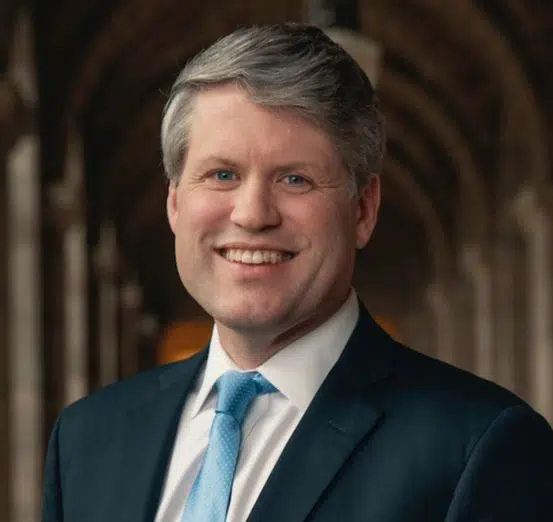
NE Attorney General Mike Hilgers
Nebraska Attorney General Mike Hilgers has filed a lawsuit seeking to block Omaha’s new minimum-wage ordinance, arguing that the city is attempting to impose wage requirements that conflict with state law.
The complaint, filed August 18 in Douglas County District Court, asks a judge to declare Omaha Ordinance 44716 invalid and prevent city officials from enforcing it. The ordinance is scheduled to take effect October 1.
Omaha’s ordinance establishes a minimum wage of $15 an hour within the city and applies that rate to employees regardless of age. Beginning January 1, 2027, the city’s minimum wage would be adjusted annually according to changes in the Midwest Consumer Price Index for All Urban Consumers.
Nebraska lawmakers changed the state Wage and Hour Act earlier this year through Legislative Bill 258. That law fixes annual increases in the statewide minimum wage at 1.75 percent. It also allows employers to pay workers aged 14 or 15 a minimum wage of $13.50 per hour.
The state law separately permits employers to pay a $13.50 training wage to newly hired workers aged 16 to 19 during their first 90 days of employment.
Hilgers argues Omaha’s ordinance directly conflicts with both provisions. Because the city requires a $15 minimum regardless of age, an Omaha employer paying the youth wage expressly permitted by state law could face penalties under the city ordinance.
According to the complaint, an employer violating the Omaha ordinance could be assessed a $500 civil penalty for each violation, along with unpaid wages and other remedies payable to affected employees. Each day a violation continues could be treated as a separate offense.
The lawsuit also challenges Omaha’s method for calculating future wage increases. State law calls for a fixed annual increase of 1.75 percent, while Omaha would use changes in the Midwest consumer price index.
The complaint estimates that, based on recent inflation, Omaha’s minimum wage could increase to $15.45 in 2027 while the statewide wage would rise to $15.26. The filing also acknowledges that inflation could fall below 1.75 percent in some years, potentially leaving Omaha’s calculated wage below the state requirement.
Hilgers contends the Nebraska Wage and Hour Act creates a comprehensive statewide system that leaves no authority for cities to adopt separate minimum-wage policies. The state’s three legal claims allege field preemption, conflict preemption and action beyond the Omaha City Council’s legal authority.
“Our Constitution does not permit the City of Omaha to repeal any portion of a statewide law passed by the Legislature,” Hilgers said in a statement announcing the lawsuit.
The attorney general also argues that minimum-wage policy is a matter of statewide concern because local wage requirements could affect labor markets, business costs and prices beyond Omaha.
The city ordinance was approved by the Omaha City Council on July 14 and signed by Mayor John Ewing Jr. on July 21. The lawsuit names the city, Ewing, the seven City Council members and Omaha Human Rights and Relations Director Cailin Daly Dejillas as defendants in their official capacities.
The filing draws heavily on a similar dispute involving the City of Lincoln. Lincoln approved its own local minimum-wage ordinance in May, prompting Hilgers to file a lawsuit in Lancaster County District Court.
On July 17, a Lancaster County judge temporarily prevented Lincoln from enforcing its ordinance. The judge found the state was likely to prevail on the merits, according to the Omaha complaint. That preliminary ruling did not constitute a final decision in the Lincoln case.
In the Omaha lawsuit, Hilgers is requesting temporary and permanent injunctions barring enforcement of the ordinance. He is also asking the court to prevent Omaha officials from enacting subsequent wage ordinances that violate state law.
The complaint represents the state’s allegations. The provided court materials do not include a response from Omaha or a ruling from the Douglas County District Court.