



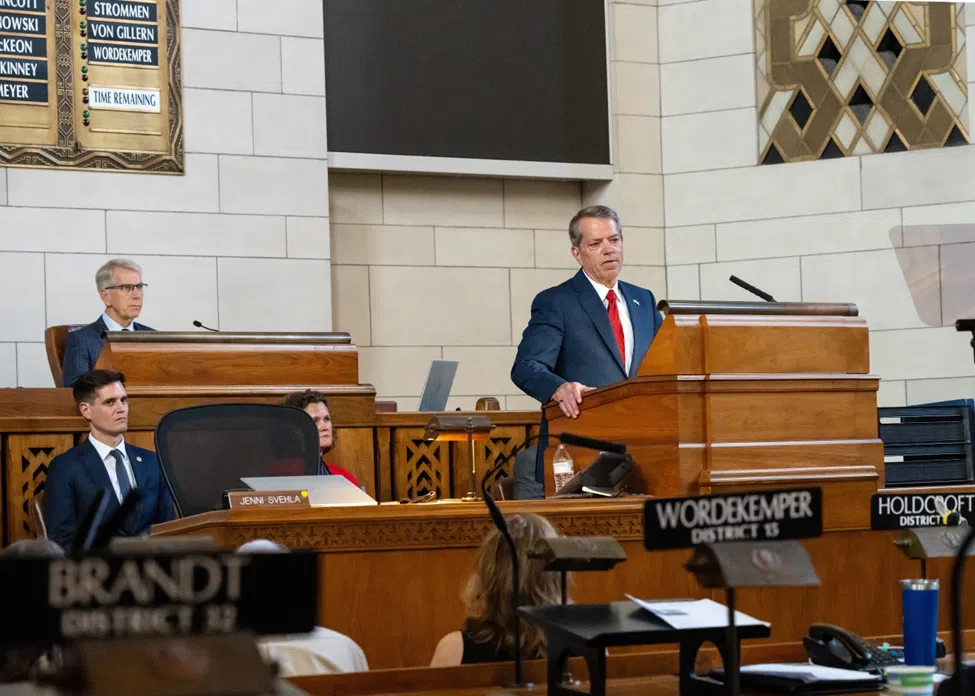
On the final day of Nebraska’s 2026 legislative session, some lawmakers reversed course on four previously approved pieces of legislation and voted to sustain vetoes issued the day prior by Gov. Jim Pillen.
On Thursday, Pillen returned five bills to the body without his signature and allowed one to become law notwithstanding. All five vetoed bills were introduced by Democratic lawmakers.
Four of those lawmakers filed motions Friday to override the governor’s objections. Each motion failed to gather the 30 votes necessary, despite most passing all three rounds of debate with veto-proof majorities.
AFFORDABLE HOUSING
LB 839, from Sen. Victor Rountree of Bellevue, sought to adjust biennial reporting requirements for cities to report to the Legislature’s Urban Affairs Committee on their efforts to address the availability of and incentives for affordable housing. Particularly, it would have barred the state from approving financial assistance for construction of a multifamily rental unit project unless a certain percentage of units were accessible to persons with mobility, hearing, and vision impairments.
In his veto letter, Pillen called new regulations for affordable housing “counterintuitive.”
Lawmakers initially passed the bill 34-15. The override motion failed on a 19-28 vote.
While debating the override motion Friday, Rountree likened the shift from his colleagues to an act of “deception.”
MEDICAID COST-SHARING
LB 929, from Sen. John Fredrickson of Omaha, sought to clarify the ability of managed care organizations (MCOs)—private insurers that administer Medicaid benefits under contract with the state—to cover deductibles and cost-sharing fees for Medicaid enrollees if they so choose. This measure was significantly pared back during first round of debate, in a compromise with the state.
Pillen called the bill “do-nothing legislation” in his veto letter. Fredrickson said Friday, lobbying his colleagues to reject the veto, the bill was a “proactive step to reassure Nebraskans that we have their back when it comes to access to care.”
Lawmakers initially passed the bill 31-18. The override motion failed on a 22-26 vote.
PAID PARENTAL LEAVE
LB 878, from Sen. Dunixi Guereca of Omaha, sought to create a paid parental leave benefit for Nebraska state employees, providing up to six weeks (240 hours) of paid leave after the birth or, namely, adoption of a child.
In his veto letter, Pillen suggested that employee benefits should be negotiated through collective bargaining, as opposed to being mandated by law.
“[This measure] is an extremely modest proposal that helps our state employees, all of our state employees, plan for their future and expand their families,” Guereca said Friday.
Lawmakers initially passed the bill 41-7. The override motion failed on a 21-27 vote.
SNOW, ICE, FLOOD RESPONSE
Lastly, LB 1256, from Sen. John Cavanaugh of Omaha, sought to clarify that snow removal, ice control and flood response count as emergency services under state law.
In his veto letter, Pillen suggested that adding these duties to the list of emergency management functions would allow political subdivisions to “circumvent” an existing cap on property taxing authority, and the allowances could cost the state $40 million annually.
Hoping to convince his colleagues, Cavanaugh said called the governor’s objection “simply wrong.”
“Property taxes being able to be increased as a result of snow and flooding is in a law that the governor passed, advocated for, signed, and has celebrated,” he said, referring to LB 34, dubbed the Property Tax Growth Limitation Act.
Lawmakers initially passed the bill unanimously 49-0. The override motion failed on a 23-22 vote.
REPORTABLE FUNDING FROM FOREIGN ADVERSARIES
The only bill vetoed by the governor without an attempt to override was LB 1029, from Sen. Danielle Conrad of Lincoln, which sought to redefine terms relating to reportable funding from a foreign adversarial source for Nebraska colleges and universities.
The governor argued that exempting employment contracts, salaries and wages from existing university reporting requirements would make Nebraska an “outlier and a soft target” for infiltration by foreign adversaries, namely, the People’s Republic of China and the Chinese Communist Party.
Conrad did not file a motion to override Pillen’s veto Friday. Lawmakers initially passed this bill on a 29-20 vote.