



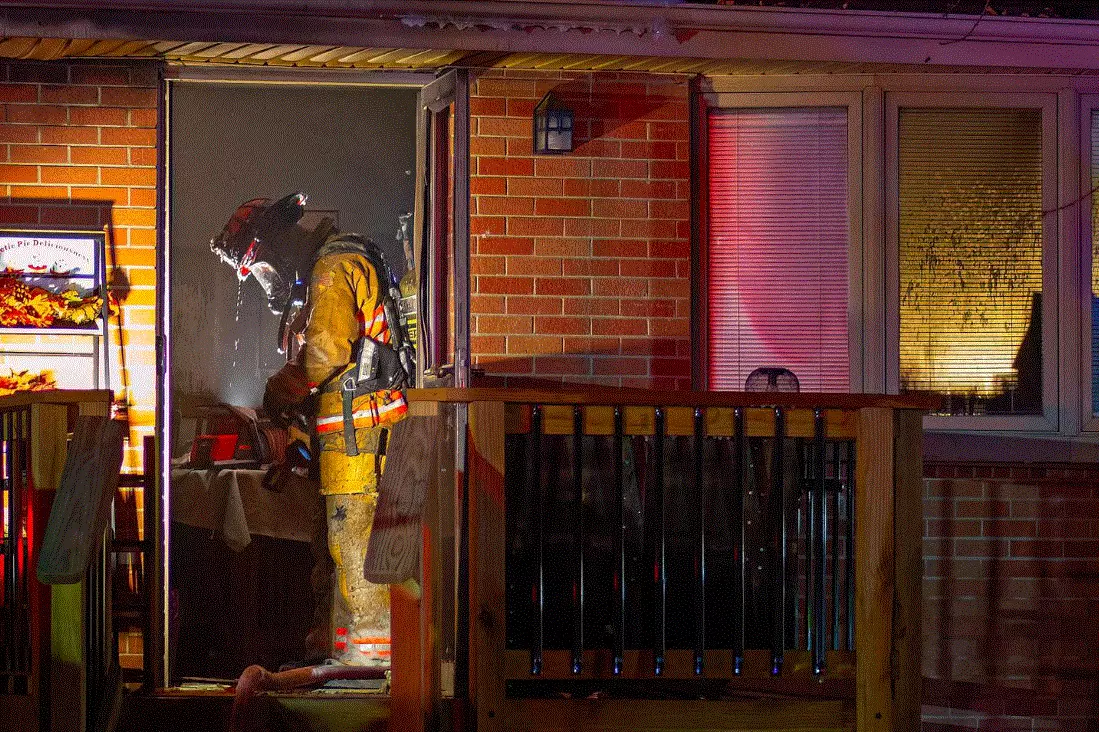
A new bill before Nebraska lawmakers would require that a medical expert be consulted before a firefighter battling cancer could have their workers’ compensation claim denied.
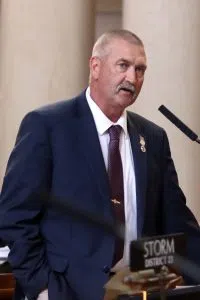
Senator Dave Wordekemper of Fremont – District 15 (Photo: Nebraska Unicameral Information Office)
State Sen. Dave “Woody” Wordekemper, a firefighter and paramedic from Fremont, introduced the bill (LB400) saying the measure amounted to “whether we stand with the men and women who protect us, or whether we turn our backs on them when they need us most” — a characterization which perturbed opponents, who said the bill would really amount to an unfunded mandate and questioned whether volunteer firefighters should qualify.
Wordekemper has 38 years of firefighting experience—30 years as a professional and eight years as a volunteer. He cited data on the floor Tuesday from organizations like the National Institute for Occupational Safety and Health, showing that firefighters face a 9% increase in cancer diagnosis and 14% increase in cancer related deaths compared to the general population. Since 2000, Wordekemper said Nebraska has seen nine line of duty deaths of firefighters from occupational cancer.
“Every one of those firefighters left behind a family, and every one of them deserved better than to be forced to prove their cancer was work related while they were still fighting for their lives,” said Wordekemper.
Firefighting, in and of itself, was designated as a “group 1” carcinogen—the highest level of cancer risk—by the International Agency for Research on Cancer in 2022. Of the 556 recognized carcinogens, 135 are “group 1,” and only two professions are listed. This is independent of specific exposures to other carcinogens during the act. In fact, Wordekemper detailed that firefighter gear itself is riddled with PFAS, or “forever chemicals,” and other cancer causing agents.
“What more proof does a dying firefighter need?” the lawmakers asked.
Under current Nebraska law, firefighters diagnosed with cancer while on the job are required to prove it. Many must hire a lawyer, haggle with insurance companies, produce evidence and expert testimony, whilst undergoing treatment. The only time a firefighter’s cancer is presumed to be connected to their occupation is if they die.
If LB400 becomes law, firefighters diagnosed with cancer, with at least five years on the job, would have “a rebuttable presumption” that certain cancers are “occupational” and thus covered by workers’ compensation programs. Employers seeking to contest that presumption would need to seek a medical opinion to prove so. Evidence that a cancer originated from a difference source could then be presented to rebut the presumption.
According to Wordekemper, Nebraska would join 28 states with similar legislation, including Iowa, which expanded cancer coverage for first responders to include all cancer types in 2025.
“The opposition will try to make it sound like this is an automatic payout with no accountability. It’s not.” Wordekemper said. “Firefighters don’t want to die. They don’t want to leave their jobs, their families, their fellow firefighters. They’re not looking for handouts.”
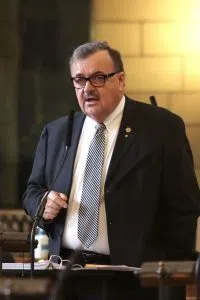
Senator Mike Jacobson of North Platte – District 42 (Photo: Nebraska Unicameral Information Office)
The lawmaker shared that the League of Nebraska Municipalities, a non-profit representing cities and villages across the state, voiced concerns, including weather volunteer firefighters would be covered. Volunteer firefighters comprise the vast majority of the state’s force. Of the 17,218 active firefighters in Nebraska, 89% (15,419) are unpaid. Of 478 departments, 94% (449) are completely volunteer.
To address this, a forthcoming amendment to the bill will add certain qualification criteria, like thresholds on years of service, drill participation, and call response.
Wordekemper is steadfast on keeping volunteers coverage in the bill, saying “cancer doesn’t discriminate between paid and volunteer firefighters… I ask that we refrain from attaching hostile amendments that only jeopardize a bipartisan piece of legislation that will protect those who protect us.”
Sen. Mike Jacobson of North Platte spoke in opposition to the bill, noting, “I’m opposed not because I oppose firefighters… But this is the mother of all unfunded mandates.”
The principle of “rebuttable preemption,” according to Jacobson, would “open up the floodgates” for any volunteer firefighter diagnosed with cancer to qualify for this benefit. He speculated that cities and villages would leverage property taxes to afford the cost.
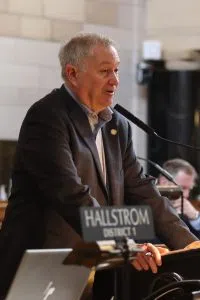
Senator Bob Hallstrom of Syracuse – District 1 (Photo: Nebraska Unicameral Information Office)
“We’re $471 million in the red. Where are we supposed to get that money?” Jacobson asked.
This issue is personal to Jacobson. On top of the lawmaker currently fighting melanoma, his nephew is a paid firefighter in the state. “I still like my nephew. I’m not sure he thinks as much of me today as he did a year ago, because I oppose this bill.”
“I’ve never been a firefighter, but gosh, somehow I’ve got cancer,” Jacobson said. “Cancer happens.”
Sen. Bob Hallstrom of Syracuse also spoke in opposition to the bill. He too, took issue with the assertion that his stance was tantamount to “turning his back” on firefighters. “Nothing could be further than the truth,” he said.
After hearing from business leaders during committee hearings, Hallstrom said he’s concerned about the “proverbial camel’s nose under the tent,” namely, if employees in other jobs that reasonably cause cancer could start to seek the same presumption under workers’ comp.
“I think we’re disrupting the workers’ compensation system,” he said.
Lawmakers did not take a vote on the bill. It’s slated to come up for second-round debate on Wednesday, Jan. 21.