


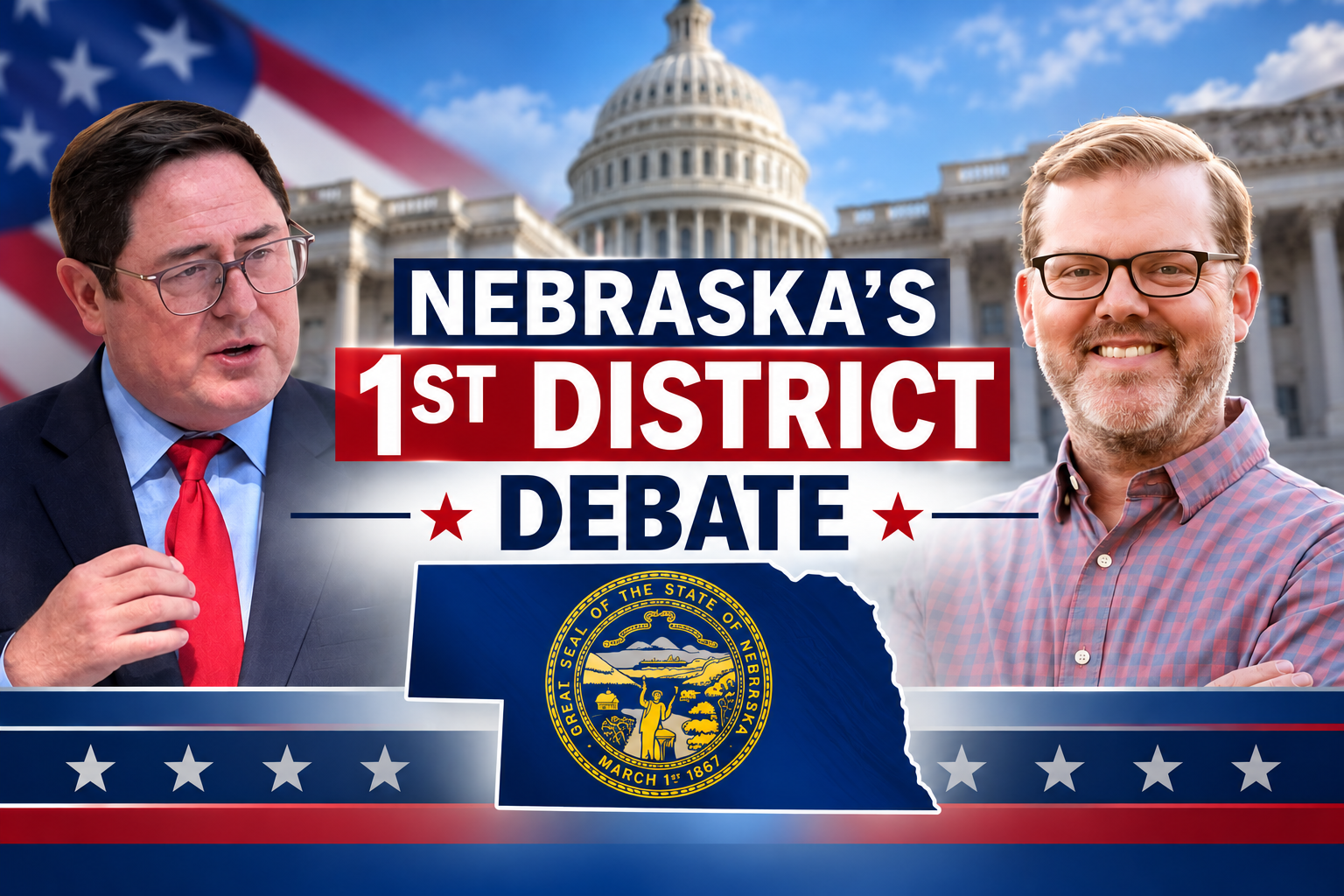
Republican Congressman Mike Flood and Democratic challenger Chris Backemeyer laid out sharply different approaches to foreign policy, health care and immigration during Wednesday night’s debate in Nebraska’s 1st Congressional District, while finding some common ground over the development of data centers.
The debate was hosted by Nebraska Public Media and the Omaha World-Herald. The district includes Lincoln, Norfolk, Columbus, Fremont and portions of Sarpy County. Flood has represented the district since 2022.
One of the most locally relevant exchanges involved data centers. Backemeyer said communities need greater transparency about water and electricity use and other impacts before projects are approved. He said local communities should ultimately decide whether they want the developments.
Flood also opposed federal intervention in local siting decisions, saying local zoning boards should retain that authority. He said recently approved federal legislation is intended to prevent additional electricity-generation costs required by large AI facilities from being shifted to existing ratepayers.
Flood also said Nebraska’s environmental resources, including the Ogallala Aquifer, must be protected. Both candidates discussed the need to require developers to provide tangible benefits to the communities hosting the facilities.
Foreign policy and its economic consequences produced a much sharper disagreement. Moderators noted diesel prices had climbed above six dollars a gallon in Nebraska as farmers prepared for harvest and cited an estimate of roughly $1 billion in combined corn and soybean losses.
Flood acknowledged that fuel costs are too high and said options ranging from export restrictions to changes in federal fuel taxes should be considered. But he defended continued U.S. involvement in Iran, arguing the country must not be allowed to obtain a nuclear weapon.
Backemeyer, who worked on Iran policy during his State Department career, argued that Congress has failed to demand clear objectives and an exit strategy. He also tied the conflict and the administration’s tariff policies to higher costs for Nebraska farmers and consumers.
The candidates also split over Medicaid. Flood defended changes enacted by Congress, including work requirements for some able-bodied adults. Backemeyer argued the changes could harm people struggling to maintain employment or care for family members who depend on Medicaid.
Immigration enforcement produced another notable exchange. Flood said he supports ICE and Customs and Border Protection but criticized fatal encounters involving ICE agents in Minnesota, saying what happened there “was not right.” Backemeyer also called for secure borders but argued ICE should be reined in and returned to a stronger focus on counterterrorism and cross-border criminal activity.
On Social Security, Backemeyer proposed raising the earnings ceiling subject to Social Security payroll taxes. Flood declined to endorse a specific financing option, instead calling for bipartisan negotiations and describing Social Security as an “ironclad promise.”
The University of Nebraska also came up. Backemeyer advocated restoring and increasing federal research support and limiting student-loan interest rates. Flood pointed to more than $100 million in support for agricultural research at Nebraska Innovation Campus and said he opposed members of his own party when they sought reductions in NIH and agricultural research funding.
Nebraska Public Media has its debate coverage and information about the 2026 congressional races on its Campaign Connection site. The debate can be viewed on Nebraska Public Media’s YouTube page.