



Nebraska Attorney General Mike Hilgers has sued Lincoln city officials over their decision not to place proposed City Charter amendments on the November 3 ballot, escalating a dispute over whether the city must bypass or accelerate its usual public review process.

Lincoln City Attorney, Yohance Christie
City Attorney Yohance Christie announced Thursday evening that Good Government Lincoln submitted its replacement petition signatures too late for the city to complete all required steps before the September 1 ballot-certification deadline.
Christie said amendments supported by enough verified signatures would instead be placed on Lincoln’s May 2027 general city election ballot.
Hilgers argues the Nebraska Constitution requires the city to place any timely and legally sufficient charter petition before voters at the next eligible election. His lawsuit contends Lincoln officials have no discretion to delay qualifying amendments until May.
Two of the three petitions had received enough verified signatures by the time Christie issued his decision. The Lancaster County Election Commission was still reviewing the third.
The proposed amendments would:
* Limit City Council members to two consecutive four-year terms.
* Move Lincoln’s municipal elections from odd-numbered years to even-numbered years.
* Allow certain residents within Lincoln’s three-mile extraterritorial jurisdiction to vote in municipal elections, except on city bond questions.
Hilgers: Duty is “non-negotiable”
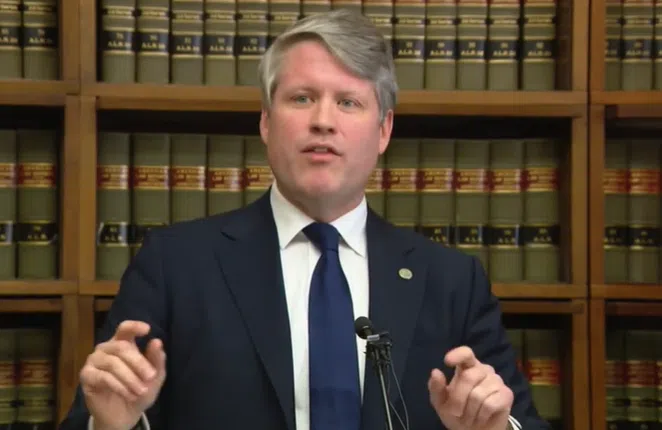
Nebraska Attorney General Mike Hilgers
Hilgers began increasing pressure on city officials earlier in the week.
On Monday, he issued an attorney general’s opinion concluding that qualifying charter amendments must be placed on the November ballot. On Tuesday, he gave city officials until 5 p.m. Thursday to indicate whether they would certify the measures before the September 1 deadline.
During a Wednesday news conference, Hilgers described the city’s obligation as “non-negotiable” and “non-discretionary.”
His lawsuit argues that the Nebraska Constitution directs city officials to submit a compliant charter petition at the next election occurring more than 30 days later. Hilgers maintains that language imposes a mandatory—or ministerial—duty on the city.
According to the lawsuit, “the city has no discretion to keep a timely and compliant petition off the November ballot.”
Hilgers also contends that the constitutional deadline for certifying a charter amendment could extend into early October. Christie, however, points to state and local election laws establishing September 1 as the controlling certification deadline for the November 3 ballot.
The disagreement over which deadline and process control is now at the center of the lawsuit according to the Nebraska Examiner.
City says required steps cannot be completed
Christie says signature verification is only one part of the process for placing a charter amendment before Lincoln voters.
According to the city, the remaining requirements include:
* Review of the petition language by the City Law Department.
* Consideration and drafting of possible alternative amendments.
* Independent review by the bipartisan Charter Revision Commission.
* Recommendations from that commission to the City Council.
* Proper public notice.
* Consideration at two City Council meetings.
* A public hearing.
* A final council vote.
“The petitioners have missed the deadline for the City Council’s process to allow inclusion on the November 3rd ballot,” Christie said.
He said the council is “under no obligation to bypass” its established process because petition organizers did not secure verification earlier.
Christie said the city would place the qualifying amendments on the May 2027 ballot pursuant to state law. That outcome is no longer certain because Hilgers is seeking court intervention before Tuesday’s deadline.
Political dispute intensifies
Lincoln City Council Chairman Brodey Weber, a Democrat, accused Hilgers of improperly intervening in the local charter amendment process and engaging in “the worst kind of political theater.”
“The City of Lincoln was not responsible for Good Government Lincoln’s failure to appropriately ensure that the signatures being collected were legitimate,” Weber said.
He said the city now has an obligation to conduct its due diligence and follow the correct legal process.
Weber unsuccessfully challenged Hilgers, a Republican, for a seat in the Nebraska Legislature in 2020.
Hilgers is a former state senator from northwest Lancaster County and lives within Lincoln’s three-mile extraterritorial jurisdiction. That means he could be directly affected by the proposal allowing certain residents outside the city limits to vote in municipal elections.
Hilgers acknowledged Wednesday that he “absolutely” supports Good Government Lincoln’s campaign. He said he had encouraged support for the proposals and might contribute financially if city officials prevented them from reaching the November ballot.
The attorney general has transferred operational control of his office’s assistance in the Lancaster County petition-fraud investigation. He said he does not consider his support for the amendments a conflict with his responsibility to uphold the Nebraska Constitution.
Jessica Flanagain, a partner with Axiom Strategies, has served as a political consultant to both Good Government Lincoln and Hilgers. That connection does not establish a legal conflict or determine the merits of the lawsuit, but it has become part of the political criticism surrounding the case.
Campaign declines comment
Good Government Lincoln declined to comment Thursday on the city attorney’s decision, according to the Nebraska Examiner.
The campaign initially submitted more than 30,000 petition signatures in July. Election officials rejected more than 65 percent of them, with a large majority of the rejected signatures flagged as potentially fraudulent.
Paid petition circulators have been arrested as part of the investigation. Those arrests and allegations do not establish that Good Government Lincoln’s sponsors directed or knew about fraudulent activity.
After the initial petitions failed, the campaign resumed collecting signatures and submitted a replacement set in August.
The term-limits proposal was certified with 5,628 valid signatures. The election-date amendment was certified with 5,568. Approximately 5,000 valid signatures were required for each measure.
The third proposal, involving voting rights for certain residents of the extraterritorial jurisdiction, remained under review Thursday.
Court decision could come quickly
The timing leaves little room for an extended court proceeding.
September 1 is the city’s stated deadline for certifying measures for the November 3 ballot. Unless a court orders the city to act—or agrees that a later constitutional deadline applies—the two verified proposals are expected to be scheduled for May 2027.
The unresolved legal questions include whether the Nebraska Constitution requires immediate certification once sufficient signatures are verified and whether Lincoln’s charter-review procedures can lawfully delay a qualifying amendment until the next city election.
Until a court answers those questions, neither November 2026 nor May 2027 should be described as the settled election date for the qualifying amendments.