



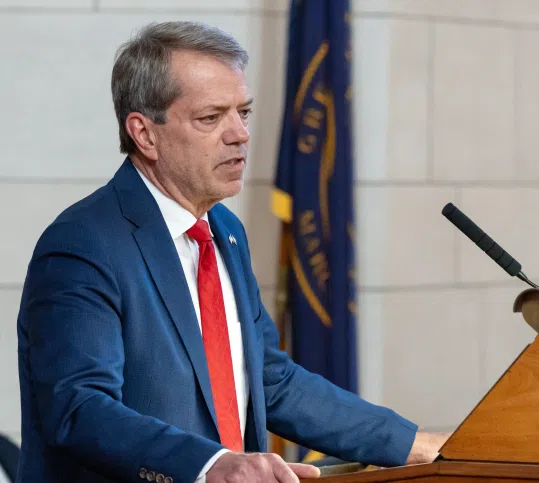
Gov. Jim Pillen used his annual State of the State address Thursday to highlight economic growth, spending cuts, and a slate of conservative policy priorities he wants lawmakers to advance during Nebraska’s short 2026 legislative session.
Opening his remarks, Pillen reflected on his recovery from a horseback riding accident one year ago, thanking First Lady Suzanne Pillen and Nebraskans for their support. He then turned to what he called a consequential year for both the state and the nation.
Pillen said his administration has worked to “shrink government” by reducing contractor use, bringing state employees back to in-office work, and cutting waste. He credited the Trump administration for unlocking new opportunities for Nebraska.
Among the accomplishments he cited Nebraska becoming the first state to ban soda and energy drinks from SNAP benefits, being the first state to opt into the federal Scholarship Tax Credit, and Nebraska ranking in the top 10 states for Rural Health Transformation funding (receiving more than $218 million).
Pillen also highlighted the recent opening of the ICE detention facility in McCook, calling it part of Nebraska’s role in federal immigration enforcement.
The governor said Nebraska’s economy has rebounded strongly, posting the sixth-highest quarterly GDP growth rate in the nation and surpassing two million residents for the first time in state history.
He emphasized agriculture, ethanol, manufacturing, and healthcare as key drivers, noting Nebraska is now the nation’s top ethanol producer and cattle state.
To grow the workforce, Pillen promoted the proposed Grow the Good Life Incentive, which would offer businesses a 10% tax credit for 10 years if they bring new, high-paying jobs to the state.
Turning to the legislative session, Pillen highlighted his budget proposal, introduced on his behalf by Speaker John Arch, which he said would cut spending and improve the state’s bottom line by $500 million this biennium.
He rejected claims of a looming budget crisis, pointing to nearly $2 billion in general fund reserves and Nebraska’s highest credit rating ever. Pillen said additional property tax relief transfers are planned later this year.
Despite the short session, Pillen urged lawmakers to act on several priorities, including:
- Placing a constitutional amendment on the 2026 ballot to restore winner-take-all allocation of Nebraska’s electoral votes (Sen. Myron Dorn’s LR24CA)
- Adopting a state antisemitism definition policy (LB538)
- Revising a 2023 law that limits suspensions for disruptive K-2 students
- Eliminating DEI and CRT programs from Nebraska’s public higher education system through the state budget
- Passing “protections for girls’ restrooms and locker rooms,” building on last year’s legislation
Pillen closed by urging lawmakers to set aside politics, focus on fiscal restraint, and seize what he described as a pivotal moment for Nebraska’s future.