



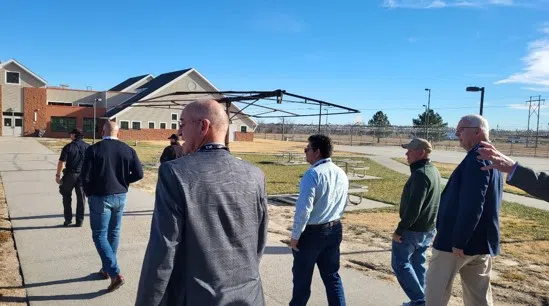
After one lawmaker was denied a tour of the Nebraska Work Ethic Camp (WEC) in McCook—now converted into a federal ICE detention facility—the state corrections director hosted a tour for five lawmakers Monday.
The five state senators in attendance included Tom Brandt, Rob Clements, Myron Dorn, Margo Juarez, and Dan Lonowski. The Office of Governor Jim Pillen said the invitation was open to all 49 state senators. Sen. Machaela Cavanaugh of Omaha was denied access on Nov. 12 and 13, supposedly due to not providing sufficient notice for a visit and needing to conform to “federal ICE protocols.”
Nebraska State Law permits any “member of the legislature” to visit “any facility in the Department of Correctional Services at any time.”

Photo Courtesy: The Office of Governor Jim Pillen
“Now that it has been up and running successfully for some time, it is a good opportunity for senators to come and see first-hand the operational aspects of the detention facility,” said Pillen in a statement.
Nebraska Department of Correctional Services (NDCS) Director Rob Jeffreys and the cluster of lawmakers visited housing units where detainees were currently living and toured admissions, dining, and medical areas inside the facility. They also walked around the outdoor recreation area, which is surrounded by a security fence.
Prior to this visit, McCook Mayor Linda Tayor and Police Chief Kevin Hodgson had their own tour of the facility.
While the facility is managed and staffed by the state, it’s housing federal detainees accused of violating immigration laws as they await their hearings for deportation. Pillen has repeatedly said the inmates are “low to medium-low offenders.” At this time, the facility is housing only men.
The facility began accepting detainees in early November. Construction begins this week to expand the facility’s capacity from 200 to 300 detainees.
NDCS is expected to be compensated $2,456,138.64 per month from the federal government, based on the expected use of the facility and costs associated with providing services to ICE. The arrangement will net the state around $14.25 million annually, according to Pillen’s office. The current contract period will expire Sept. 29, 2027.