




Since declining to a record low in April of last year, the Creighton University Mid-America Business Conditions Index, a leading economic indicator for the nine-state region stretching from Minnesota to Arkansas, has remained above growth neutral for 15 of the last 16 months.
Overall Index: The Business Conditions Index, which uses the identical methodology as the national ISM, ranges between 0 and 100, fell to a healthy 68.9 from July’s 73.1. Supply managers reported that supply chain bottlenecks represented the greatest challenge for the next 12 months and was restraining growth.
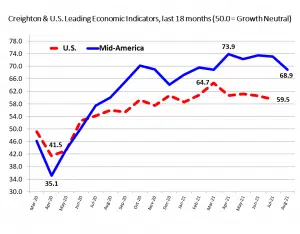
“Creighton’s monthly survey results indicate the region is adding manufacturing business activity at a healthy pace, and that regional growth will remain positive, but somewhat slower. Supply chain bottlenecks and labor shortages remain obstacles to growth,” said Ernie Goss, Ph.D., director of Creighton University’s Economic Forecasting Group and the Jack A. MacAllister Chair in Regional Economics in the Heider College of Business.
“Approximately 94% of supply managers reported supply chain bottlenecks for the month with half of those detailing significant supply disruptions,” said Goss.
Employment: The regional employment index remained above growth neutral for August, but sank to 64.6 from July’s two decade high of 67.2. “Even with strong manufacturing job growth, the region has yet to recover all job losses from the pandemic. The latest U.S. Bureau of Labor Statistics data indicate that current regional nonfarm employment is down by 431,000 jobs, or 3.3%, compared to pre-COVID-19 levels,” said Goss.
Even with healthy job growth for the month, firms continue to report difficulties in finding and hiring new workers. One of five supply managers said finding and hiring qualified workers will be the greatest challenge for the next 12 months.
As reported by one supply manager, “Where did all the workers go?”
Other comments from supply mangers in the August survey were:
- “Very difficult to get balance. Feel like a ‘fiddler on the roof.’”
- “There has been a significant movement away from plastic products to paper-based packaging. This has significantly added to an already constrained market.”
- “We are a heavy and medium duty truck dealership with sales, rental/leasing, service, parts and collision centers. Biggest challenges are delays on factory orders of new trucks with demand far outpacing supplies/deliverable orders.”
- “Supply bottlenecks on assembly parts, collective bargaining work stoppages impacting new truck production, driver shortages are all impacting our sales efforts.”
Wholesale Prices: The wholesale inflation gauge for the month slipped to 95.0 from July’s record high 98.7.
Said one supply manager, “(It) will take a long time to catch up to demand, passing along rising prices does not seem to be denting demand.”
As reported by supply managers, rising input prices represented the second greatest challenge or threat faced by their firm over the next 12 months.
“At the wholesale level, Creighton’s survey is tracking higher and higher inflationary pressures. Commodity prices are up approximately 20.9% over the last 12 months, according to U.S. Bureau of Labor Statistics data. Supply managers in Creighton’s June survey expect prices for their firm’s products to advance by 7.7% for the next 12 months,” said Goss.
Confidence: Looking ahead six months, economic optimism, as captured by the August Business Confidence Index, dipped to 53.5 from July’s 53.6. This is the third straight month that the index has declined.
Inventories: The regional inventory index, reflecting levels of raw materials and supplies, plummeted to 54.9 from 70.7 in July.
Trade: Despite supply chain bottlenecks, regional trade numbers were solid for the month. The new export orders index expanded to a very healthy 64.7 from July’s 63.9. Supply bottlenecks pushed the August import reading to a lower 52.4 from 65.3.
Other survey components of the August Business Conditions Index were: new orders advanced to 75.8 from 73.5 in July; the production or sales index declined to 65.0 from July’s 67.9; and the index reading for the speed of deliveries of raw materials and supplies was unchanged from July’s index of 84.5. A higher reading indicates slower deliveries.
The Creighton Economic Forecasting Group has conducted the monthly survey of supply managers in nine states since 1994 to produce leading economic indicators of the Mid-America economy. States included in the survey are Arkansas, Iowa, Kansas, Minnesota, Missouri, Nebraska, North Dakota, Oklahoma and South Dakota.
The forecasting group’s overall index, referred to as the Business Conditions Index, ranges between 0 and 100. An index greater than 50 indicates an expansionary economy over the course of the next three to six months.
The Business Conditions Index is a mathematical average of indices for new orders, production or sales, employment, inventories and delivery lead time. This is the same methodology, used since 1931 by the Institute for Supply Management (ISM), formerly the National Association of Purchasing Management. The Mid-America report is produced independently of the national ISM.
Arkansas: The August Business Conditions Index for Arkansas declined to 69.3 from 71.2 in July. Components from the August survey of supply managers were: new orders at 74.4, production or sales at 68.1, delivery lead time at 83.9, inventories at 53.7, and employment at 66.5. “Durable goods manufacturers in the state are expanding at a solid pace adding both jobs and hours worked, while Arkansas nondurable goods producers are experiencing more modest growth,” said Goss.
Iowa: Iowa’s Business Conditions Index for August climbed to 68.2 from 67.9 in July. Components of the overall July index were: new orders at 77.2, production, or sales, at 63.2, delivery lead time at 84.3, employment at 61.4, and inventories at 54.8. “Both durable goods and nondurable goods producers in the state are expanding at a solid pace. Metal products manufacturing and food producers are experiencing very healthy growth,” said Goss.
Kansas: The Kansas Business Conditions Index for August declined to 70.4 from 73.3 in July. Components of the leading economic indicator from the monthly survey of supply managers were: new orders at 74.5, production or sales at 71.2. delivery lead time at 84.4, employment at 67.1, and inventories at 55.0. “Both durable and nondurable goods manufacturers in the state are advancing at a healthy pace. Nondurable goods producers are increasing the average hourly work week at a healthy pace,” said Goss.
Minnesota: The August Business Conditions Index for Minnesota dropped to 71.1 from July’s 77.4. Components of the overall August index were: new orders at 78.3, production or sales at 63.6, delivery lead time at 86.0, inventories at 58.7, and employment at 68.9. “Both durable and nondurable goods manufacturers in the states are expanding at a healthy pace. Durable goods producers are increasing the average hourly work week at a healthy pace with medical equipment manufacturers leading the way,” said Goss.
Missouri: The August Business Conditions Index for Missouri rose to 75.2 from 71.3 in July. Components of the overall index from the survey of supply managers for August were: new orders at 76.6, production or sales at 65.5, delivery lead time at 94.1, inventories at 61.6, and employment at 78.1. “Nondurable goods manufacturers in the state are growing at a solid pace while Missouri durable goods producers are experiencing more modest growth. Computer and related producers in the state are expanding at a healthy pace,” said Goss.
Nebraska: Nebraska’s overall index for August dropped to 68.6 from 70.4 in July. Components of the index from the monthly survey of supply managers for August were: new orders at 74.7, production or sales at 63.4, delivery lead time at 85.4, inventories at 57.3, and employment at 62.3. “Both durable and nondurable goods manufacturers in the state are expanding at a solid pace with food processors leading the way,” said Goss.
North Dakota: The August Business Conditions Index for North Dakota fell to 63.6 from 74.0 in July. Components of the overall index for August were: new orders at 73.7, production or sales at 62.3, delivery lead time at 80.7, employment at 55.4, and inventories at 46.1. “Both durable and nondurable goods manufacturers in the state are expanding at a healthy pace by expanding both employment and average hours worked,” said Goss.
Oklahoma: Oklahoma’s Business Conditions Index expanded above growth neutral in August. However, the overall index sank to 68.4 from 72.7 in July. Components of the overall August index were: new orders at 74.3, production or sales at 71.4, delivery lead time at 83.6, inventories at 53.1, and employment at 59.3. “While expanding output at a solid pace, durable good manufacturers in the state are adding few jobs in the past several months while nondurable goods producers are expanding at a solid pace with food processors leading the way,” said Goss.
South Dakota: The August Business Conditions Index for South Dakota fell to 67.3 from 72.5 in July. Components of the overall index from the August survey of supply managers in the state were: new orders at 74.1, production or sales at 62.8, delivery lead time at 82.8, inventories at 51.2, and employment at 65.2. “Nondurable goods manufacturers in South Dakota are expanding at a healthy pace, while durable goods producers are experiencing a much more modest expansion,” said Goss.
Survey results for September will be released on Oct. 1, 2021, the first business day of the month.
Source: Creighton University News Release